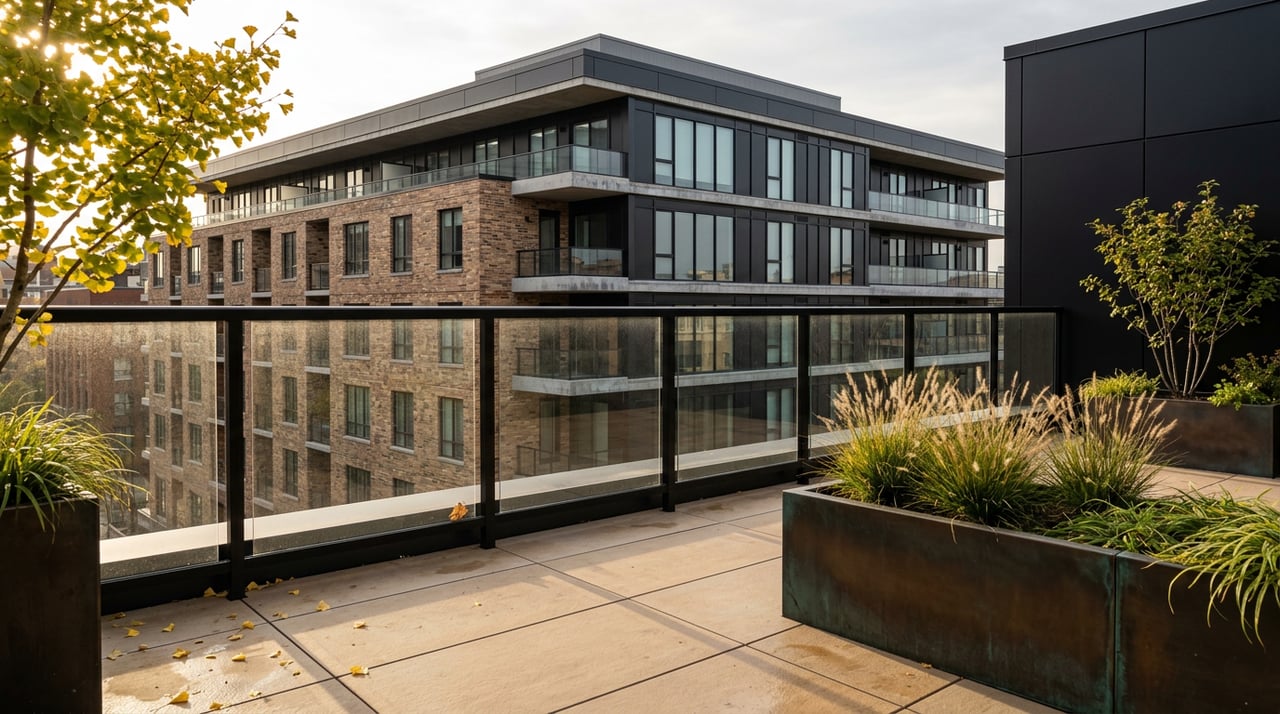
Walk south on Hennepin from Franklin some weekday morning and you will pass a dark storefront with a parking lot that still has lines painted for cars that no longer come. That is 2112 Hennepin, where The Lowry served eggs and oysters to bus drivers, bar owners, and Kenwood parents alike for fifteen years before closing for good on April 26, 2026. The windows are papered over. The building is listed as a turnkey second-generation restaurant space, hood vents and all, waiting for whoever wants to take a run at it next.
Here is what makes that empty storefront worth stopping for. The road out front finished construction nearly six months before The Lowry closed. Hennepin Avenue's two-year, $36 million reconstruction between Lake Street and Douglas Avenue wrapped with a ribbon-cutting in late October 2025. City officials called it a generational investment. Mayor Jacob Frey told the crowd it was time to come back and support the businesses that had weathered the disruption. Everyone on that stretch of Hennepin had spent two years believing the same thing: once the cones come up, things go back to normal.
They did not. And understanding why tells you more about what this corridor is becoming than any construction update ever could.
The Timeline Everyone Got Backward
Most of the coverage of Hennepin Avenue's construction years followed a simple arc: disruption, then relief. Businesses suffered while the street was torn up, then recovered once it reopened. That arc holds for some storefronts. It does not hold for two of the corridor's longest-tenured names.
The Lowry closed six months after the ribbon-cutting, not during construction. Blue Plate Restaurant Co., which owned the diner, cited changing consumer behavior and city-specific mandates alongside what it called prolonged and disruptive Hennepin Avenue construction, but the timing matters: this was a post-reopening closure, not a during-construction one. Nearly fifty employees were offered spots at the company's other Twin Cities restaurants.
About five weeks after that, Red Cow announced it would close its Hennepin Avenue location on June 1, ending a ten-year run. Owner Luke Shimp told the Star Tribune that sales had dropped 60 to 70 percent during the two-year construction window and were still running roughly 50 percent below normal that spring, months after the road reopened. In twenty-four years in the restaurant business, he said, it was the first time he had ever chosen not to renew a lease. Both restaurants are part of the same family: Shimp and Blue Plate co-founder Stephanie Shimp are siblings, and their businesses sat blocks apart on the same stretch of road.
The president of the Uptown Business Association, Andrea Corbin, has pointed to more than 60 business closures along the corridor in recent years. Her explanation is not just that construction hurt everyone equally. It is that the finished street itself, not the disruption of building it, is now part of what determines who survives.
What the New Design Actually Rewards
Here is the part that gets left out of the "Uptown is coming back" framing. The reconstructed Hennepin Avenue is not the same street with fresh pavement. It is a different street, on purpose. The project cut car travel from four lanes to two, added a raised median, built out protected bike lanes, and installed dedicated bus infrastructure for the new METRO E Line, which began service in December 2025 with stations at Franklin Avenue, 25th Street, and the Uptown Transit Station.
Corbin's read is that the new layout is frustrating for drivers trying to reach Hennepin businesses, particularly with the median limiting left turns. A gallery manager on the corridor has said as much directly: clients have complained about the new median and the loss of easy left turns since the road reopened. One person biking the corridor offered the opposite read entirely, telling a local TV crew the redesign made the ride safer and was the reason they were on Hennepin at all.
Both things are true at once, and that is the point. A business built around drive-up convenience, a big parking lot, and easy car access on a four-lane road is now operating on a two-lane street with a median in the middle. A business built around people already walking, biking, or riding the E Line past the front door is operating on a street built for exactly that. The Lowry had a parking lot. Red Cow had 52 spaces, a rarity in Uptown. Both leaned on car access that the new design was never going to prioritize.
Who's Moving Into the Empty Spaces
If the mechanism above is right, you would expect the businesses filling these vacancies to look different from the ones that left. They do.
Harold's Chicken, the Chicago fried chicken chain, is opening a sports bar and rooftop at the corner of Hennepin and Lagoon, taking over the multi-level space most recently home to Cowboy Slim's and Daisy's. It is a concept built around game-day crowds arriving on foot or by bus for an evening out, not a daytime diner crowd pulling into a parking lot. A few blocks south, Arizona Taco Co. is opening its second Twin Cities location inside the former Arts & Rec and Libertine space at 3001 Hennepin, another walk-up, evening-oriented concept rather than an all-day sit-down restaurant.
Neither of these is replacing what The Lowry or Red Cow offered. They are betting on a different customer, one who is already moving through the corridor on the new infrastructure rather than driving in and parking.
The Corner That Never Struggled
The businesses that never left tell the same story from the other direction. Namaste Café, the Indian and Nepali restaurant with the patio at 2512 Hennepin, has operated through the entire construction window and the restaurant shakeout that followed. So has Isles Bun & Coffee, whose owner has run the business for nearly thirty years and described the past three or four as the hardest stretch he's seen, largely because of construction, not because the finished street failed him. PRVDR and Uptown Balloons both told local reporters at the reopening ceremony that they were focused on rebuilding traffic, not on abandoning the corridor. Specs Optical's manager said she was looking forward to new businesses arriving and more foot traffic overall.
None of these are car-dependent, drive-up businesses. They are neighborhood fixtures built around people who already live within walking distance, and that is precisely the population the new Hennepin Avenue was designed to move, whether on foot, by bike, or on the E Line.
What's Actually on the Calendar This Month
None of this is abstract if you live in Lowry Hill right now. The corridor's daily rhythm this September looks like this:
- The Uptown Farmers Market runs Thursdays from 4 to 8 p.m. at Lagoon & Girard Plaza through September 24, meaning there is just over a week left in this year's run.
- Open Streets Hennepin, the Uptown Association's car-free celebration of the avenue, closes food vendor registration on September 15 and general registration on September 29, turning the finished street back into a pedestrian space for a single day.
- The Lowry Hill Neighborhood Association's Green Team is hosting a lake cleanup on September 19 from 9 to 11 a.m. at the Minneapolis Sailing Center.
- That same Saturday, September 19, the neighborhood's walking and safety group meets at Sebastian Joe's from 10 to 11:30 a.m., a low-key way to see the corridor on foot with neighbors.
Taken together, these are the events of a neighborhood settling into what its main street has actually become, not the one it used to be. The empty diner at 2112 Hennepin is not evidence that Uptown failed. It is evidence that a street built for four lanes of car traffic and a big parking lot doesn't automatically support the same businesses once it's built for something else. What fills that space next will tell you a lot about who the corridor is for now.
If you're watching this stretch of Lowry Hill change and wondering what it means for a home you already own here, or one you're thinking about, MN Living Real Estate has spent years reading these shifts block by block. Let's Connect.